Heartworm Disease: The Forbidden Spaghetti
The Analogy
The Heart: An oval-shaped muscle that constantly fires electrical signals to pump oxygenated blood throughout your body.
Angel Hair Pasta: A long, thin noodle used to fill the hole in my heart.
"While this may be an overdramatization of my love for pasta, it is a reasonably accurate description of heartworm disease in dogs: A plate of angel hair pasta crammed inside a heart."
What is it? Heartworm disease is caused by long, thin worms that infect the heart, pulmonary artery, and lungs.
The Damage: They block blood flow, forcing the heart to work harder.
The Result: Heart failure, lung disease, coughing, lethargy, and potentially death.
Transmission: The Mosquito Myth
"But mosquitoes aren’t out in the winter, right?" Tell me you haven't woken up in February with a mosquito buzzing around your head.
The Reality: Mosquitoes transmit heartworm larvae. Even if Fluffy doesn't go outside much, that one 2 AM mosquito can infect him or her.
Choose Your Fighter: Scenario 1 vs. Scenario 2
Scenario 1: The Responsible Owner
You give heartworm prevention year-round.
The Mechanism: The prevention kills the larvae before they mature into worms.
The Bonus: Most oral preventatives also treat intestinal parasites and external pests.
Read more in my guide on Fleas and Ticks.
The Option: For forgetful owners (often husbands), there is an injectable prevention that lasts 6-12 months.
The Annual Test: "But I gave the pills!"
The Question: "If I give the meds every month, why do I still have to pay for a test every year?"
The Answer: Even with the best intentions, things happen.
Real Life: Dogs are sneaky. They can vomit the pill behind the couch 10 minutes after you walk away, or you might accidentally miss a dose during a chaotic week.
Resistance: While rare, resistant heartworm strains do exist in some areas.
Safety: This is the big one. Giving certain heartworm preventatives to a dog that is already positive can cause a severe, life-threatening shock reaction. We need to confirm they are negative to keep them safe.
Scenario 2: The "I Forgot" Approach
You missed the doses, and Fluffy got bitten.
Growth: Over 6 months, microscopic larvae grow into 6–12 inch adults.
Damage: These worms live for 5–7 years, clogging the arteries and thickening the heart walls.
Symptoms: Coughing, rapid breathing, and exercise intolerance.
The Treatment
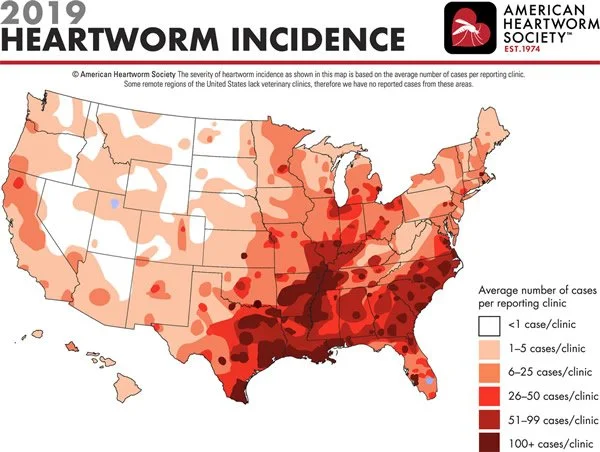
Heartworm Incidence has increased across the country every year.
"It will cost an arm and a leg." If your dog tests positive, the road is long and dangerous.
Prevention: ~$10–20 / month (approx. $150/year).
Treatment: ~$1,200–$2,500+ (plus X-rays, bloodwork, and hospitalization).
The Math: You could pay for 15 years of prevention for the cost of one treatment.
The Kill Shot: Prevention kills babies, but we need a specialized arsenic-based injection to kill the adults.
The Risk: As the worms die, they turn into "dying spaghetti noodles" that can cause blockages or anaphylaxis.
The Recovery: Strict cage rest, steroids, and antibiotics are required to keep the dog safe while the worms dissolve.
A Note on Cats
"Cats are aliens." They can also get heartworm, but the disease behaves differently (because, of course, it does). They should absolutely be on monthly prevention.
Their symptoms are very similar to those of asthma (Heartworm Associated Respiratory Disease).
The first sign of heartworm in cats is typically sudden death.
Resources For the deep dive, the American Heartworm Society is the gold standard resource.